


Version 1.1
Published: 13th April 2026
1. Introduction
1.1. About Everyone TV
1. Everyone TV is responsible for the day-to-day running of the UK’s main free TV platforms. Owned and supported by the UK’s leading public service broadcasters – the BBC, ITV, Channel 4 and Channel 5 – we are the champions of free TV, of the value it delivers for viewers and the positive impact it has on wider society.
2. Under our current form as Everyone TV and formerly as Digital UK, we have historically been the organisation responsible for running Freeview, the UK’s largest TV platform, which originated as a broadcast TV service delivered by aerial and has evolved to also offer a hybrid broadcast/on-demand TV service (called Freeview Play). Following the completion of a merger with Freesat in 2021, we are now also the organisation responsible for providing free-to-air broadcast TV services by satellite.
3. Part of our remit is to lead free TV’s evolution for a digital age. The expectation is that there will be greater use of IP as a distribution technology for free TV services in the years ahead, and that Digital Terrestrial Television (DTT) and Digital Satellite (DSat) – the technologies currently used to deliver Freeview and Freesat, respectively – are unlikely to remain the primary means to deliver free TV services for ever.
4. In this context, we have developed Freely, a future-facing next generation platform that viewers will be able to use over the coming decade and beyond, which is intended to operate regardless of the technologies by which TV channels are distributed. This free TV service allows British viewers to easily browse and watch live TV channels together with on-demand content streamed straight to their smart TV via broadband.
5. The Policy set out in this document forms an important part of the framework for Freely.
1.2. Context and definitions for LCN Policy
6. This is Everyone TV’s LCN Policy for Freely (henceforth referred to as the ‘Policy’) and applies solely to Freely.
7. The Policy sits alongside the DTT LCN Policy (which covers Freeview and Freeview Play) and the Freesat EPG Listing Policy, which continue to apply to those platforms. For the avoidance of doubt, channel numbers on Freeview, Freeview Play and Freesat are not affected by this LCN Policy for Freely.
8. Everyone TV handles the day-to-day technical management of the EPGs on the platforms for which we are responsible. As part of this, we allocate logical channel numbers (‘LCNs’) – the unique numbers assigned to channels that viewers use to select channels, and which determine the order in which channels are presented on the EPG – and manage the launch of new services onto the platforms.
9. A core development principle for Freely is that it should be agnostic in relation to distribution technologies, so it can be used by viewers regardless of the technologies by which TV channels are distributed. To ensure a seamless user experience, the Policy ensures that TV channels on Freely will be accessed via a single unitary EPG regardless of how they are delivered, and alternative versions of a single channel will generally be allocated a single channel number.
10. In June 2023 we consulted publicly on our proposals for a ‘Logical Channel Number Policy for a Next Generation Platform’. On 9 January 2024, we published a statement1 setting out our decisions on the Policy in the light of the responses that we received to the consultation. In March 2026, we consulted on amendments to the Policy, and on 13th April 2026 we published a statement2 setting out our decisions on those amendments, again in light of the responses received. This Policy implements the decisions set out in those statements and will govern the way in which Everyone TV will allocate LCNs on the Freely platform.
11. The Policy has been designed to meet the following objectives:
- Make it easy for viewers to discover content through simple navigation;
- Ensure the ongoing prominence of public service channels;
- Protect consumers from potential harm (e.g. ensure Children’s content is distant from any Adult content); and
- Allocate and manage LCNs fairly and efficiently.
We also seek to give channel providers the opportunity to reach viewers, and make it easier for viewers to transition to IP-delivery for free TV in the years ahead.
12. Everyone TV will continue to have regard to these objectives in the ongoing operation and management of the Policy. Where relevant, Everyone TV may weigh up the relative importance of the objectives and proceed according to its judgment as to how those objectives are best met. Everyone TV will however apply the Policy consistently to channels and channel providers and seek to operate in a fair, reasonable and non-discriminatory manner.
13. After an LCN allocation has been made by Everyone TV, the LCN continues to belong to Everyone TV and will remain subject to its discretion and the Policy. Everyone TV reserves the right to move a channel to an alternative LCN in accordance with this Policy. For the purposes of this Policy, the following definitions are applied, as shown in Table 1 (defined terms are shown in bold when they appear in other definitions in the table):
Table 1: Definition of terms used
Term | Definition |
|---|---|
‘Broadcasting’ | In this Policy, the term ‘broadcasting’ is used when referring to linear channels regardless of whether they are delivered via traditional broadcast (DTT or DSat) or are IP-delivered. |
‘Channels’, ‘Channel providers’, ‘Radio stations’ | For the sake of convenience, the term ‘channels’ is used to refer to all services that will be allocated LCNs within this Policy, and those who provide such services are referred to as ‘channel providers’. These services may include television, radio and text. ‘Radio stations’ may also be used in clauses relating specifically to radio. |
‘Channel families’ | ‘Channel families’ are two or more channels that:
Channel families may include public service channels. For the avoidance of doubt, a channel family may comprise public service channels only, non-public service channels only, or a mixture of public service channels and non-public service channels. When a channel family comprises a mixture of public service channels and non-public service channels, non-public service channels cannot take advantage of rules relating to channel families that would put them into a more prominent LCN due to their association with public service channels in their channel family. |
‘Common branding’ | ‘Common branding’ may take a number of forms. In considering whether two channels have common branding, Everyone TV will consider the following non-exhaustive factors: the names of the channels, and the look and feel of their logos and idents. |
‘Common control’ | Channels will be considered to be under ‘common control’ where they are owned or controlled by companies in the same corporate group. The corporate group consists of a holding company and all its subsidiaries, the terms ‘holding company’ and ‘subsidiary’ having the meanings given in section 1159 of the Companies Act 2006. In addition, where a holding company directly or indirectly holds 50% of the voting rights in a channel which does not otherwise fall within the definition of ‘subsidiary’ in section 1159 of the Companies Act 2006, that channel will be treated as under common control with any of the holding company's subsidiaries with which the channel in question has common branding. |
‘DSat’ | Abbreviation for ‘Digital Satellite’. |
‘DTT’ | Abbreviation for ‘Digital Terrestrial Television’. For the avoidance of doubt, a channel will be described as being distributed by DTT only if it is a ‘pure’ DTT channel, as opposed to a Hybrid Streamed channel that relies on both DTT and IP for its distribution. |
‘EPG’ | Abbreviation for ‘Electronic Programme Guide’, the on-screen menu that tells viewers what programmes are available on their television. |
‘Freely’ | The free TV platform developed by Everyone TV, which operates in a distribution-technology-neutral manner. |
‘Genre Categories’ | ‘Genre Categories’ are the genre-based categories used to organise the EPG. A range of LCNs is assigned to each Genre Category. When a channel launches on the platform, it is allocated an LCN within the Genre Category relevant to the channel. The full list of Genre Categories and their definitions is provided in Schedule 2. |
‘Higher LCNs’, ‘Lower LCNs’ | ‘Lower LCNs’ refers to lower channel numbers; i.e. smaller numbers which appear closer to the beginning of the LCN list. ‘Higher LCNs’ refers to larger channel numbers which are further away from number 1 in the LCN list. |
‘Hybrid Streamed channels’ | ‘Hybrid Streamed channels’ are channels where audio-visual content is delivered over IP but access is enabled via an MHEG or HbbTV application that is broadcast over DTT. |
‘IP-delivered channels’, ‘IP-only channels’ | ‘IP-delivered channels’ are IP channels delivered via a Freely-approved method, meaning that they conform to technical specifications set out by Everyone TV, and to all other requirements detailed in the Freely Content Provider agreement. Everyone TV may make adjustments to the technical specifications and/or approval criteria from time to time. IP-delivered channels are not dependent in any way on DTT for their delivery (unlike Hybrid Streamed channels). This term does not refer to IP channels in the OS and Device Partner range. Such channels are not allocated LCNs by Everyone TV. We have reserved a range of LCNs in which OS and Device Partners may allocate LCNs (see Schedules 1 and 2). ‘IP-only channels’ are IP-delivered channels that are not also delivered on Freely in similar form via DTT or DSat. |
‘LCN’ | Abbreviation for ‘Logical Channel Number’. LCNs are the unique numbers assigned to channels that viewers use to select channels, and which determine the order in which channels are presented on the EPG. For ease of exposition, the term is sometimes also used to refer to the EPG slot that an LCN is associated with. So, for example, we refer to a “vacated LCN” as shorthand for a vacated slot that was used by a channel that had been assigned the LCN. |
‘Device/OS Partner’ | An entity who has entered into an agreement with Everyone TV to make Freely available on one or more devices and/or operating systems (OS) provided by that entity. |
‘Periodic Reordering’ | A periodic reordering of the LCN listing as set out in Chapter 6. |
‘Policy’ | The ‘Policy’ refers to this document, i.e. Everyone TV’s LCN Policy for Freely. |
‘Policy Review’ | A review of the Policy as set out in Chapter 6. |
‘Public service channels’, ‘Non-public service channels’ | ‘Public service channels’ are those channels identified as such in accordance with section 310 of the Communications Act 20033. When allocating LCNs to public service channels, Everyone TV will seek to fulfil the objective of ensuring the ongoing prominence of public service channels (one of the objectives for the Freely LCN Policy, see paragraph 11). Any channels that are not public service channels may be referred to as non-public service channels in sections of the Policy when we need to draw a distinction between public service channels and non-public service channels. |
‘Terms’ | The Terms and conditions of LCN allocation, namely the Freely LCN Allocation Terms and Conditions. |
14. Previous decisions of Everyone TV regarding the allocation of LCNs prior to the adoption of this version of the Policy will not be considered relevant in the interpretation of this Policy and will not bind Everyone TV as precedent.
1.3. Key organising principles for the Policy
15. Reflecting the distinctive characteristics of the platform, this Policy differs – both in the overall approach and the detailed rules – from equivalent policies for other platforms, including those managed by Everyone TV. This section highlights key organising principles as they relate to Genre Categories, ensuring prominence for public service channels, the ordering of channels in each Genre Category, and the allowance of channel pairings.
16. For the avoidance of doubt, these principles were established to determine the allocation of LCNs on the initial EPG when the platform launched (see section 5.1), and to inform any reallocation of LCNs in our Periodic Reorderings (see Chapter 6). The rules relating to the allocation of specific LCNs to channels in the normal course of business are detailed in Chapters 2-5 and 7, and in Schedules 1-3.
17. The EPG is organised according to a series of Genre Categories, with a range of LCNs assigned to each category. The main TV Genre Categories are:
- Entertainment
- Time-shift channels
- News
- Children’s
- Music
- Shopping
- Faith & International
There are also Genre Categories for Hybrid Streamed, Adult and Radio channels.
18. Our approach to ensure ongoing prominence of public service channels is as follows:
- We allocate the first five LCNs (1-5) to the five main public service channels in each Nation in the UK.
- We allocate further prominent LCNs to other public service channels in the Entertainment Genre Category, including local TV and Nations-specific channels (in the initial Freely line-up, LCNs 8-12 are used).
- We allocate the first slots in the News and Children’s sections to public service channels in those Genre Categories.
19. After allocating LCNs to public service channels, our guiding principle for the ordering of channels in each Genre Category is to put the most popular channels at the start of the EPG. For the initial Freely line-up, we used each channel’s reach as the main criterion (for TV channels, average weekly 5-minute reach on DTT measured over a full year). In subsequent Periodic Reorderings, we may use another metric as appropriate4. (This does not apply in the Faith & International, Shopping, Hybrid Streamed, Text, and Adult Genre Categories.)
20. As we allocate channels to each LCN slot we allow each channel to bring with it a second channel from its family (the one with the next highest reach) to create a channel pairing. (Again, this does not apply in the Faith & International, Shopping, Hybrid Streamed, Text, and Adult Genre Categories.)
1.4. Prominence for public service channels
21. Everyone TV will seek to give ‘appropriate prominence’ to public service channels in the appropriate Genre Category following the scheme set out in the Ofcom EPG Code applicable to the DTT and DSat EPGs. This is achieved through the mechanisms outlined in paragraph 18, and sections 5.2.1 and 5.7.
22. Some public service channels are deemed to be public service channels only in certain Nations or regions of the UK. Outside of that area, the channel will be treated as a non-public service channel. If the broadcaster chooses to distribute a channel on Freely outside of the geographical area for which it is a public service channel, it will be allocated a separate LCN in the areas where it is treated as a non-public service channel.
23. Some channels might be deemed to be public service channels throughout the whole UK but may be entitled to specific minimum prominence levels in a particular Nation or region (their ‘core area’). If this area-specific prominence is achieved by means of sharing an LCN with other public service channels, then the channel may be allocated a separate LCN outside of its core area. For the avoidance of doubt, it will be treated as a public service channel outside of its core area, even though it may have a less prominent slot than it has in its core area.
24. Broadcasters may offer IP-delivered versions of their channels, and these will be allocated appropriately prominent LCNs if they are public service channels and otherwise allocated LCNs as non-public service channels. (DTT and IP-delivered versions of a channel would share an LCN, in the usual way, see Section 5.5.)
2. Requirements to be eligible for an LCN
25. A prerequisite for any channel seeking an LCN from Everyone TV for Freely is that the channel must conform to all relevant requirements for accessing the platform. These requirements include but are not limited to:
- the requirements of this Policy;
- the channel or channel provider being appropriately licensed5;
- a DTT or DSat carriage agreement with a multiplex operator (a ‘carriage agreement’); or, if a channel provider has sublet capacity, appropriate evidence that they have an agreement in place to access DTT or DSat capacity; or, in the case of IP-delivered channels, a Freely Content Provider agreement with Everyone TV;
- arrangements for providing EPG schedule data (a ‘schedule provider agreement’);
- any other relevant commercial and content terms; and
- any technical specifications.
26. Terms and conditions of LCN allocation are contained within the Freely LCN Allocation Terms and Conditions (the ‘Terms’). By making an application to Everyone TV for allocation of an LCN, or broadcasting a channel using an LCN, channel providers also agree to be bound by the Terms. Furthermore, the benefits of this Policy are only available where the channel provider accepts the Terms in full.
27. Where there is a change of control of a channel or a channel provider, it is the responsibility of the new provider to comply with the Policy and the Terms.
28. In order to be allocated or retain an LCN, channels must broadcast a minimum of six hours per day or 42 hours per week of audio-visual content via DTT, DSat or as an IP-delivered channel6. A static slate does not count as audio-visual content for the purpose of this rule. However:
- This rule applies to channels distributed by DTT or DSat, and to IP-delivered channels. This rule does not apply to Hybrid Streamed or Text channels7, or to channels in the Adult genre or the Radio genre.
- Certain rights apply to channels that launched prior to publication of this Policy and which have broadcast on the DTT platform continuously for a period up to the publication of the Policy (these rights will still apply if channels take breaks in broadcasting provided the breaks do not exceed 12 weeks (or 84 days) in any 12-month rolling period):
- Channels which were broadcasting on the DTT platform before 3 April 2017, and which were broadcasting for less than two hours per day or 14 hours per week on DTT prior to this date, do not need to comply with additional minimum broadcast hours requirements in this Policy until the expiry of their DTT carriage agreement that was in place at 3 April 2017. After the expiry of that DTT carriage agreement, they must comply with the minimum broadcast hours requirement in sub-bullet point (ii) below.
- Channels which were broadcasting on the DTT platform before 1 March 2021 do not need to comply with the six-hours minimum broadcast hours rule, but must broadcast a minimum of two hours per day or 14 hours per week of audio-visual content. This minimum broadcast hours requirement may be fulfilled via DTT, DSat or as an IP-delivered channel.
- Any channel which ceased broadcasting on DTT (other than the permitted breaks of up to 12 weeks (or 84 days) accrued in any 12-month rolling period) and relaunched at a later date will be assessed according to the date on which it recommenced broadcasting.
- A channel may reduce its broadcast hours to less than the minimum threshold for up to 12 weeks (or 84 days), accrued in any 12-month rolling period. The channel provider should (where circumstances permit) notify Everyone TV in advance in writing before reducing its broadcast hours. If a channel falls below the minimum broadcast hours for more than 12 weeks (or 84 days) accrued in any 12-month rolling period then, upon notice from Everyone TV to the channel provider, its LCN will be withdrawn.
If a channel changes its name, we will assess on a case-by-case basis whether it should be treated as the same channel for the purposes of this minimum-hours rule (covering all the bullet points above), taking into consideration the name of the channel, the nature of its content and its Ofcom licence number.
29. A channel provider may cease to make a channel available for up to 12 weeks (or 84 days) in any rolling 12-month period without losing its LCN. The channel provider should notify Everyone TV in advance in writing of its intention to temporarily cease broadcasting its channel. If the channel does not resume broadcasting within the 12-week time limit, then the LCN will be deemed vacated and can be re-allocated by Everyone TV in accordance with this Policy.
30. Everyone TV may allocate LCNs for test channels if, at its absolute discretion, it thinks it appropriate to do so.
3. Application for an LCN
31. Any channel provider which requires an LCN should submit its LCN application to Everyone TV between eight and four weeks prior to the channel provider’s intended launch date of the channel. Applications received less than four weeks before the intended launch date of the channel will be processed, but in such cases Everyone TV cannot guarantee that the intended launch date will be met.
32. When preparing an LCN application, a channel provider should be able to demonstrate that its channel conforms to all relevant requirements for accessing the platform, as detailed in Chapter 2.
33. To that end, as part of its application the channel provider should:
- provide evidence confirming that its channel meets the criteria for an LCN as set out in Chapter 2. Evidence of a carriage agreement will be by way of a letter of corroboration from the relevant multiplex operator; and
- state which Genre Category it believes would be most appropriate for the channel (as listed and defined in Schedule 2); and
- at its cost, supply Everyone TV with any other information as specified in the allocation process or as Everyone TV may otherwise reasonably request regarding the channel.
The channel provider must ensure that all information provided by it or on its behalf is accurate, complete and up-to-date. In the event that the information provided by a channel provider is inaccurate, incomplete or out-of-date, Everyone TV reserves the right to suspend or reject the application unless and until accurate, complete and up-to-date information is provided. Once a valid application with the relevant detail is received, it will usually take two weeks for Everyone TV to allocate an LCN to the channel.
34. Everyone TV will review the proposed Genre Category, in accordance with Schedule 2 of this Policy. If the channel might meet the definition of more than one Genre Category, the following considerations will apply, in this order:
- Whether any consumer protection issues might exist (in particular, any service which would qualify for an LCN in the Adult Genre Category will be placed in that genre).
- Whether the channel is Hybrid Streamed, Text or Radio in nature.
- The nature of the content on the channel as per the genre definitions set out in Schedule 2.
35. If a channel is allocated an LCN and does not launch within eight weeks of the specified launch date, the LCN which was allocated to the channel may be withdrawn.
36. Requests for an LCN made on a speculative basis (i.e. channels without confirmed genre and intended launch date) will not be considered. However, Everyone TV will be willing to engage in confidential pre-application discussions with channel providers about the availability of LCNs and other matters connected with the operation of Policy and will permit the use of ‘working’ channel names in any application for an LCN.
37. The LCN allocation process may change from time to time.
4. Genre Categories
38. Genre Categories are the basis for grouping channels. They assist viewer navigation and can protect consumers from content that may harm or offend. The EPG is divided into a series of Genre Categories, to each of which a range of LCNs has been allocated for use by channels that meet the relevant criteria.
39. The Genre Categories on the EPG include traditional TV genres (such as Entertainment and News) and categories defined by the nature of their channels’ distribution or type of media (such as Hybrid Streamed and Radio). See Schedule 2 for the full list of Genre Categories and their definitions.
40. Each channel on Freely is assigned an LCN within the relevant Genre Category for the channel (in accordance with the process set out in Chapter 5).
41. Everyone TV may from time to time add, remove, merge or move Genre Categories, following a Review process (see Chapter 6) that may be followed by a consultation (see Chapter 7). This may occur, for example, if it proves necessary to allocate additional LCNs to a particular Genre Category that is close to using up, or has used up, its allocation of LCNs.
42. In the event a Genre Category overflows its prescribed LCN range before additional LCNs can be assigned to it, Everyone TV will temporarily place any additional channels of that Genre Category in the most appropriate alternative location as determined by Everyone TV (an ‘overflow’ section).
43. Definitions of the Genre Categories and their LCN ranges are shown in Schedule 2. Any amendments to Schedule 2 will be published on the Everyone TV website.
5. Allocation and management of LCNs
5.1 Initial allocation of LCNs on Freely launch
44. The initial LCN lineup for Freely was determined according to the key organising principles explained in Section 1.3, using a set of rules detailed in v1.0 of the Freely LCN Policy, which are explained in our LCN Statement published on 9 January 20248.
5.2 New channel launches
45. Channels that launch on the platform will be assigned LCNs according to the rules in Section 5.2.1 for public service channels and Section 5.2.2 for non-public service channels.
46. Where the channel is an alternative version of an existing channel, the rules set out in Section 5.5 will apply.
47. These rules also apply to existing channels on the platform if they change their name and/or content to a sufficient degree that the channel is more appropriately placed in a different Genre Category (see Chapter 4).
5.2.1 New Public service channels
48. Any public service channel that launches on the platform will at the very least be assigned an LCN in accordance with the prominence regime for PSB channels on regulated EPGs.
49. If there is one or more vacant LCN(s) within their relevant Genre Category at a lower position than that specified in the prominence regime for regulated EPGs, then the lowest vacant LCN would be assigned.
If we believe that there is an alternative way to deliver a more prominent LCN slot for the new channel that better meets the objectives for the Freely LCN Policy, then we will issue a consultation under Chapter 7 of this Policy on the options under consideration and decide which method to adopt in the light of the responses received.
50. In cases where there is no suitable vacant slot available for a public service channel to meet the minimum prominence obligations specified in the prominence regime for regulated EPGs, we will consider any appropriate methods of creating a suitable slot for a public service channel, issue a consultation under Chapter 7 of this Policy on the options under consideration and decide which method to adopt in the light of the responses received.
51. Where no prominence obligations are specified by Ofcom in the prominence regime for regulated EPGs, we will again consider any appropriate methods of creating a suitable slot for a public service channel, issue a consultation under Chapter 7 of this Policy on the options under consideration and decide which method to adopt in the light of the responses received.
5.2.2 New non-public service channels
52. Non-public service channels launching onto the platform will normally be assigned the next available LCN at the end of the relevant Genre Category. There may be limited instances when a new channel will be allocated a lower LCN in accordance with Vacated LCN procedures (Section 5.7).
53. As soon as a channel has been allocated an LCN, Everyone TV considers that it is occupying its LCN for the purpose of the other rules in Chapter 5, even if the channel has not yet launched or moved.
5.3 Rules specific to Radio Genre
54. The first 11 LCNs are assigned to the BBC’s national radio stations (as at 9 January 2024), in the order determined by the numbers in the station names, followed by the World Service.9 The BBC may reorder these stations, or replace them with others, at its discretion, in accordance with section 5.6.
55. The next seven LCNs slots are reserved for BBC Local and Nations Radio services operating in the household’s region. The relevant Local Radio and Nations Radio services that are mapped to these slots from the full set of BBC Local Radio services are determined by DTT transmitter coverage. Any unused slots remain vacant.
56. Local and Nations BBC Radio services are each allocated an LCN towards the end of the overall Radio Genre Category. Up to seven of these services are mapped onto prominent LCNs towards the start of the Radio Genre Category (see paragraph 55).
57. If a commercial radio provider10 wishes to offer more than one regional variant of a radio station on the platform, then the radio station will be allocated a single LCN and the provider may use that slot for the different variants around the UK.
5.4 Sharing LCNs
58. Where channels broadcast to distinct areas of the UK, and their coverage does not overlap (except where paragraph 60 applies), those channels may share an LCN if:
- all of the channels under consideration are public service channels, or
- all of the channels under consideration belong to the same channel family and are not public service channels.
Everyone TV may, in the interests of efficient use of LCN slots and viewer benefit, require that channels which meet these criteria share an LCN.
59. Where channels share an LCN and one channel expands its coverage such that it overlaps with the coverage of one or more other channels on the LCN (except where paragraph 60 applies), the expanding channel must apply for a new LCN.
60. The geographical boundaries of local public service channels will be determined according to their entitlement to PSB prominence in a particular area in light of these channels’ nature and characteristics and their intended audience. In some cases, while the channels may be licensed to serve distinct geographic areas, in practice there may be some overlap in their actual DTT coverage. In such cases, Everyone TV may decide that the channels should share an LCN.
5.5 LCN allocations when there are alternative versions of a single channel
61. There are several reasons why a Freely device may have access to two or more versions of any given channel:
- Distribution technology. If the Freely device is connected to a broadcast (DTT or, when it is available, DSat) technology as well as to the internet, there may be broadcast and IP-delivered versions of some channels.
- Video format. There may also be different versions of some channels as differentiated by their video format, e.g. standard definition (SD) and high definition (HD) versions.
- Regional content. For public service channels that are regionalised, their content may differ in different parts of the UK. In such cases, the Freely device will deliver the relevant regionalised version of the channel to each household in the region in question. But there may also exist versions of the channel on the platform that replace regional programming with alternative content.11
62. The number of versions of a channel on a Freely device may therefore vary from device to device, as determined by factors such as the technical set-up of the device, including the broadcast and IP technologies to which the device is connected.
63. When two or more versions of a channel exist on a Freely device – provided the programming on the different versions is ‘sufficiently similar’, as defined in paragraph 64 – they will be regarded as alternative versions of a single channel and treated in the following way:
The alternative versions of the channel will be assigned a single LCN.
Following the technical allocation of the multiple versions of the channel to the same LCN on the EPG, at any point in time only one version of the channel will be made available to users of the Freely device.
The decision as to which version is listed on the EPG will be at the election of the channel provider.
For example, the channel provider might decide that viewers should see the highest resolution version of the channel that is available to them.
The other versions of the channel will not normally be available to viewers.
On any given Freely device, there may be circumstances in which the version of a channel shown to the viewer changes, in line with the technical specifications for the platform. But at any point in time, only one of the alternative versions of the single channel will ever be made available to users of the Freely device.
64. The criteria that determine whether the programming on two (or more) versions of a channel is ‘sufficiently similar’ for the channels to be regarded as alternative versions of a single channel (and treated as described in paragraph 63) are as follows (the criteria differ for public service channels and non-public service channels):
For public service channels, the broadcaster will specify which version of the channel will be regarded as the ‘default’ version in accordance with their regulatory requirements. (For channels which have different regional variants, the broadcaster will specify a default version for each region.)
All of the programming on any other version of the channel must be an exact simulcast of the default version, including relevant regional programming and covering the same broadcasting hours across the day as the default version, for the alternative version to be regarded as ‘sufficiently similar’ to it.12
Differences in promotions, advertisements, and on-screen graphics and idents between different versions are permitted, and such differences would not preclude them from being treated as being sufficiently similar.
For any given public service channel, we will assign a single LCN in accordance with the prominence regime for PSB channels on regulated EPGs. Any alternative versions of the channel that are not ‘sufficiently similar’ to the default version, as defined above, will be treated as separate channels and allocated their own LCNs (see paragraph 65).
For non-public service channels, there may be some different programming between the versions, for them still to be treated as ‘sufficiently similar’.
The versions must still recognisably be simulcasts of each other, and this must be reflected in the channel name and the vast majority of programming on the alternative versions.
65. When the criteria in paragraph 64 for the programming on two (or more) versions of a channel to be ‘sufficiently similar’ are not met, the channels will be treated as separate channels and each one will normally be assigned its own LCN.
In the case of public service channels, versions other than the default version will be treated as non-public service channels for the purposes of LCN Policy rules – including rules on reordering LCNs (Section 5.6), vacated LCNs (Section 5.7) and public service prominence (Section 5.2.1). The LCNs allocated to these versions may not be traded.
66. In the circumstances described in paragraph 65, we reserve the right to refuse to allocate multiple LCNs if we feel that doing so would not be an efficient use of LCNs and/or would lead to a more confusing viewer experience. In this instance, we would allocate a single LCN and the channel provider would choose which single version of the channel to offer.
67. There may be limited circumstances in which two (or more) versions of a channel are deemed ‘sufficiently similar’ but the channel provider would like each version to be allocated a separate LCN (rather than sharing a single LCN, as described in paragraph 63). We reserve the right to agree to such requests, by exception, where we consider that doing so would lead to a significantly better viewer experience and/or would help Everyone TV to conform to any applicable regulatory requirements.
Should these limited circumstances apply, the additional LCNs will be temporary and Everyone TV will regularly review whether they are still required. The additional LCNs will be allocated at the end of the LCN range for the relevant Genre Category (in reverse order, starting with the final LCN and working backwards). For example, in the Entertainment Genre Category, we would first allocate LCN 249 to the first channel requiring one of these slots, we would then allocate LCN 248 to the next channel, and so on. Everyone TV may at any time choose to reorder these channels if that would better meet viewer expectations.
These LCN allocations will be fixed and normal rules relating inter alia to pairing, swapping, vacated channels and prominence will not apply to them. In addition, these LCNs may not be traded.
5.6 Reordering of channels, LCN trading and changing a channel’s content and/or name
68. Everyone TV will consider all applications to reorder13 LCNs of channels that are in the same Genre Category and are under common control (as defined in Table 1). LCN swaps may take place at any time (subject to paragraph 72) and do not require any justification. The channel provider should set out a preferred date for the channel changes.
Non-public service channels cannot benefit from prominence in any way through their association with public service channels in their channel family. So public service channels may swap LCNs with other public service channels, and non-public service channels may swap LCNs with other non-public service channels. But a public service channel may not swap LCNs with a non-public service channel.
69. Trading of LCNs for channels that are not under common control is permitted, including LCN swaps and the selling of LCNs. Everyone TV will consider all applications to reorder LCNs of channels that are controlled by two different channel providers. The following processes will apply (in each case, the channels under consideration must fall within the same Genre Category):
Two existing channels, each under different ownership, choose to swap LCNs with each other.
Both channel providers must write separately to Everyone TV to confirm that they wish the swap to go ahead.
An existing channel on the platform chooses to sell the right to occupy its LCN to a new channel (under different ownership).
The new channel, which must be launching into the same Genre Category, must first apply to Everyone TV to launch a new channel, following the process in Chapter 3. An LCN will be allocated to the new channel.
Both channel providers must then write to Everyone TV to confirm that they wish to swap LCNs at the point that the new channel launches.
The benefit of LCN trades between channel providers is time-limited: channels will keep their new LCNs until the next Periodic Reordering, at which point Everyone TV may assign new LCNs to the channels (see Chapter 6).
70. Public service channels that meet the criteria in paragraph 68 are allowed to reorder their channels, except those at LCNs 1-5. Public service channels may not be reordered with non-public service channels.
71. Everyone TV reserves the right to refuse any application to reorder channels where it believes that the proposed changes would not be in the best interests of viewers and listeners and/or the platform.
For example, Everyone TV may decide that it would not be in the best interests of viewers for a part-time channel to move into a more prominent position, and a full-time channel into a less prominent position. Or it may decide it would not be in the best interests of viewers for a channel that is only available to a minority of viewers to move into a more prominent position, and a channel that is available to the majority of viewers to move into a less prominent position.
72. The timing of any channel reordering must be agreed with Everyone TV. Where possible, Everyone TV will seek to co-time the reordering with other changes to the platform to minimise disruption for viewers and listeners.
These changes will take place on set days that are communicated in advance by Everyone TV. If a channel provider requests to make a change by a certain date to conform with requirements in this Policy, and we choose to implement the change on a later date, then we might at our discretion provide the channel provider with some leeway in relation to the relevant Policy requirement.
73. Channel providers may reorder the LCNs of two or more of their channels and then close one of the affected channels.
74. Channel providers may change the content and/or name of a channel, and nonetheless retain that channel’s LCN so long as it remains appropriate to the Genre Category in which it has been placed. This could mean replacing the channel with a new channel or a channel that already exists but is not currently carried on the platform.
- If the channel provider believes that the changes to the content or name of a channel mean that the channel would be more appropriately moved to a different Genre Category, then it will be treated as a new channel in that Genre Category and allocated a new LCN according to the rules in Section 5.2. The slot in the original Genre Category from which the channel is withdrawn will then be offered to other channels according to the ‘vacated LCNs’ rules in Section 5.7.
- If, at any time, Everyone TV finds, at its discretion, that a channel has changed such that it would be more appropriately placed in a different Genre Category, Everyone TV may then require that the channel be moved to that Genre Category. It will be allocated a new LCN within that Genre Category according to the same rules as for new channels set out in Section 5.2, and the vacated slot in the original Genre Category will be offered to other channels according to the ‘vacated LCNs’ rules in Section 5.7.
75. A channel provider will be charged a reasonable single fee for all LCN changes that it requests be made on a particular day, relating to swaps, trade and name changes.
76. These charges will only apply to LCN swaps, trades and name changes that are requested by channel providers. The charges will not apply to any changes which are enforced by Everyone TV, and they will not apply to changes which take place under the ‘vacated LCNs’ rules (see Section 5.7).
5.7 Vacated LCNs
77. Where a channel is withdrawn from its EPG slot for any reason and its LCN becomes available, it will trigger the vacated LCNs procedure described in the next paragraph.
78. Vacated LCNs will be offered to channels in the same Genre Category in the following order:
First, offer the vacant slot to any public service channels that exist in the relevant Genre Category in higher14 LCN positions.
The vacant slot is offered first to the public service channel that is nearest to the vacant slot and with a higher LCN within the Genre Category.
If the public service channel provider chooses not to accept the offer to move, the vacant slot is then offered to the next nearest public service channel with a higher LCN within the Genre Category, and so on until it has been offered sequentially to all public service channels at higher LCNs within the Genre Category.
At the end of this step, either a public service channel has accepted the offer to move to the vacant slot, in which case the vacated LCNs procedure is complete; or (if there are no public service channels with higher LCNs or none of them choose to move) the process continues to the next step.
Second, offer non-public service channels on either side of the vacant slot the opportunity to create a channel pairing.
Denote the channel that appears one LCN lower (i.e. closer to the start of the LCN list) than the vacant slot as Channel A1. If Channel A1 is a non-public service channel, and if there exists within the Genre Category another non-public service channel from the same channel family as Channel A1 and with a higher LCN than that of the vacant slot (denote it Channel A2), then Channel A2 would be offered the vacant slot.
If there is no such channel A2 or it does not accept the offer to fill the vacant slot, then repeat the process for the channel that appears one LCN higher than the vacant slot, to be denoted Channel B1. If Channel B1 is a non-public service channel, and if there exists within the Genre Category another non-public service channel from the same channel family as Channel B1 and with a higher LCN than Channel B1 (denote it Channel B2), then Channel B2 would be offered the vacant slot.
If there is no such channel B2 or it does not accept the offer to fill the vacant slot, then the process continues to the next step.
Third, offer non-public service channels up to five positions either side of the vacant slot the opportunity to create a semi-adjacent channel pairing.
Repeat the process described in the second step above, starting with the channel that is two positions lower than the vacated LCN (denote it Channel C1). If Channel C1 is a non-public service channel, and if there exists within the Genre Category another non-public service channel from the same channel family as Channel C1 and with a higher LCN than that of the vacant slot (denote it Channel C2), then Channel C2 would be offered the vacant slot.
If there is no such channel C2 or it does not accept the offer to fill the vacant slot, then repeat the process in the following sequence until the procedure is complete (in each step, starting the matching process with the relevant channel in the list below):
- The channel that appears two positions higher than the vacated LCN
- The channel that appears three positions lower than the vacated LCN
- The channel that appears three positions higher than the vacated LCN
- The channel that appears four positions lower than the vacated LCN
- The channel that appears four positions higher than the vacated LCN
- The channel that appears five positions lower than the vacated LCN
- The channel that appears five positions higher than the vacated LCN.
If, after offering the vacant slot to channels in the five positions on either side of it, the vacant slot has still not been filled, then the process continues to the final step.
Fourth, offer the vacant slot to the next new channel that is part of a family.
The final step is to offer the vacant slot to the next non-public service channel that launches on the platform, provided the new channel belongs to the same channel family as any existing non-public service channel in the relevant Genre Category.
Any channel provider which is offered a vacated LCN will have two weeks in which to consider the offer and respond in writing to Everyone TV. If no response is received within that timescale, Everyone TV may offer the LCN to another channel provider in accordance with this Policy.
79. In a situation where vacated LCNs have still not been filled following the vacated channel procedure set out in paragraph 78, Everyone TV may at any time (either immediately or at a later stage) undertake a ‘shuffle-down’ procedure. This operates as follows (see also the worked example in Schedule 3):
- The channel in the next highest (non-vacant) LCN will be offered the opportunity to move into the vacant LCN. They will usually be given two weeks to decide whether to take up the offer.
- No channel will be obliged to move, but if the offeree chooses not to move then the vacant LCN may be offered to the channel in the next highest (non-vacant) LCN, in which case it would leapfrog the channel that chose not to move.
- This process continues, working through successive higher LCN slots in the Genre Category, until either a channel accepts the offer to move to the vacated LCN or the vacated LCN has been offered to all channels in the Genre Category with higher LCNs. The shuffle-down procedure ends if no channel chooses to move to the original vacated LCN.
- If a channel accepts the offer to move to the vacated LCN, then that channel’s LCN becomes vacant. Where the slot (usually the first adjacent slot to the original vacant one) has now been newly vacated, the same shuffle-down procedure would apply to fill this second vacated slot, as described above, with channels in higher LCNs sequentially offered the opportunity to move into the second vacated LCN.
- If a channel accepts the offer to move to the second vacated LCN, the shuffle-down procedure continues in the same way for the third, and each subsequent, vacated slot: each time a channel accepts a move to a lower LCN, its newly vacated LCN is then offered sequentially to channels with higher LCNs.
- If at any stage in the steps described above, when a channel accepts a move to a vacated slot in a lower LCN, this involves leapfrogging over one or more other vacant slots, then the vacant slot with the lowest LCN will be regarded as the next available slot that this process seeks to fill (even if this is not the slot that has just been newly vacated).15
- The shuffle-down procedure concludes either when no channel chooses to move to a vacated LCN or when there are no more vacant LCNs in the Genre Category as all vacant slots have been filled.
- The end result, once all LCN moves have been agreed, would be a block of channels which all simultaneously shift down one or more places on the EPG.
80. If, after a shuffle-down procedure has concluded, any slot has still not been filled, then this vacant slot will be automatically allocated to the next channel that launches onto the platform.
81. As an alternative to the shuffle-down procedure, Everyone TV may use a vacated LCN for any other reason we deem reasonable.
82. Outside of the above processes, new non-public service channels launching onto the platform will be allocated the next available LCN at the end of the relevant Genre Category (see Section 5.2.2).
83. Any channel that already has an LCN on the platform which is allocated a different LCN under any of the above processes will have eight weeks to complete its move following the allocation, or it will lose the right to use the vacated LCN. Any new channel launching onto the platform into a vacated LCN will be subject to the timelines set out in Chapter 3.
84. Channels already on the platform may not request vacant LCNs from Everyone TV; Everyone TV will always offer vacant LCNs to channels as described above.
5.8 Introduction of DSat-only channels
85. If Freely should become available in devices which have the ability to make a DSat connection, LCNs will need to be allocated to DSat channels that are not available on other platforms. The process for allocating such LCNs is as follows:16
- We will consider all the DSat-only channels together and assign these channels the next available LCNs at the end of the relevant Genre Categories, in order of their popularity as determined by reach.
- Channels for which no reach data exists will then be assigned the next available LCNs at the end of the relevant Genre Category, in the same order as these channels occur in the Freesat EPG, once the DSat-only channels with reach data have been allocated slots.
86. We will publish at the time the details of the methodology for ordering the DSat-only channels.
87. When the next Periodic Reordering of the Policy takes place after the addition of DSat-only channels (see Chapter 6), all channels will be considered on an equal basis in a technology-neutral manner when the new allocations of LCNs are made.
88. Any DSat-only channel that launches on the platform after the initial allocation of LCNs to DSat-only channels set out above will be treated in the same way as any other new channel, as described in Section 5.2.
5.9 Device/OS Partner channels
89. LCNs 31 and 90–99 are reserved for channels selected by Device/OS Partners, subject to commercial agreement between Everyone TV and the relevant Device/OS Partners. Device/OS Partner channels will be allocated to those LCNs in accordance with the rules set out in the following paragraphs.
90. Everyone TV will invite Device/OS Partners to nominate candidate channels for listing in LCNs 31 and 90-99. It will be for Device/OS Partners to ensure that they have consent from channel providers for their channels to be listed in this range; Everyone TV will require Device/OS Partners to confirm they have such consent as part of the LCN allocation process.
91. To be eligible for inclusion in the LCNs 31 and 90-99, channels must comply with the Freely LCN Allocation Terms and Conditions17 and Freely’s Scope of Access requirements for IP-delivered channels18. These requirements include (but are not limited to):
- The channels must play within the Freely Player and must be delivered to our standard technical specifications;
- The channel or channel provider must be appropriately licensed19;
- The channels must ensure compliance with all Ofcom Codes applicable to broadcast television licensees;
- The feature set available for these IP streams will be in line with that available as standard across the Freely Player;
- Channels in these LCNs must meet the definition of ‘Entertainment’ as per the Freely LCN Policy.
92. Everyone TV will not agree to list any channel in LCNs 31 and 90-99 that does not meet the eligibility criteria set out above.
93. For the avoidance of doubt, if a Device/OS Partner elects to include channels in the LCN 31 and 90-99 range, those channels will not appear on the devices or OS provided by other Device/OS Partners who have listed different channels, or no channels, in those LCNs.
94. Once agreement has been reached on the channels to be listed, it will be for the Device/OS Partner to specify its preferred ordering of channels within that range in the first instance. Everyone TV would normally expect to approve the Device/OS partner's preferred ordering of channels unless there are exceptional reasons not to, in the interest of viewers and/or the platform.
95. Following the initial listing of Device/OS partner channels in LCNs 31 and 90-99, the normal rules of the Freely LCN Policy (as amended from time to time) will apply to those channels, save that:
- Device/OS Partner channels will not be eligible to move into other LCNs in the Freely EPG (meaning, for example, that those channels would not be eligible to move into vacated LCNs outside the 31 and 90-99 range);
- For the purpose of reordering/swaps (see section 5.6) within the Device/OS Partner LCNs, the channels will be treated as if they were under common control with the relevant Device/OS Partner (whether or not they are in fact under common control with the relevant Device/OS Partner);
- LCN trading will not apply;
- Where Everyone TV carries out a Periodic Reordering (see Chapter 6), it will not change the order of channels within the 31 and 90-99 range. However, Everyone TV reserves the right to move the range of LCNs allocated for Device/OS Partner channels within the Freely EPG where warranted in the context of a Periodic Reordering.
6 Periodic Reorderings and Reviews
96. Everyone TV will carry out Periodic Reorderings of the LCN listing. These will take place every three to five years, and we will provide at least one year’s notice to channel providers.
97. In each Periodic Reordering, we will determine a new allocation of LCNs in each Genre Category, following the key organising principles for the Policy set out in Section 1.3.
98. As we allocate channels to each LCN slot we allow each channel to bring with it a second channel from its family (the one with the next highest reach) to create a channel pairing. (Again, this does not apply in the Faith & International, Shopping, Hybrid Streamed, Text, and Adult Genre Categories.)
99. At the same time, we may undertake a Policy Review more broadly, in which we will evaluate its overall operation against the objectives for the Freely LCN Policy. If we believe there may be merit in amending the rules of the Policy and/or the Genre Categories then we will publish a consultation on the proposed changes, as described in Chapter 7.
100. Notwithstanding the above, we reserve the right to undertake a review of the LCN Policy at any time if we believe there are compelling platform or viewer reasons to do so, or if issues arise that need to be considered without undertaking a full Policy Review. These may include, but are not limited to, the following:
- Demand for LCNs outstrips, or is anticipated soon to outstrip, supply in a Genre Category, requiring an expansion of the allocation of LCNs to the relevant Genre Category.
- More generally, the expansion of channels on the platform indicates a need to amend the Genre Categories and LCN ranges allocated to each one.
101. Any review that takes place between Periodic Reorderings would aim to make as few changes as needed to the Policy and would be subject to a consultation process as described in Chapter 7.
7 Consultations
102. Everyone TV will consult with channel providers on any proposed enforced move of LCNs, except those that form part of a Periodic Reordering (Chapter 6). For the avoidance of doubt, Everyone TV will not consult if channels move LCNs as part of the standard procedures in this Policy for sharing LCNs (Section 5.4), requests from channel providers to reorder channels or to change a channel’s content and/or name (Section 5.6) or vacated LCNs (Section 5.7).
103. Where there are fewer than five channels to be moved, Everyone TV will generally conduct a ‘light’ consultation process, as follows:
- A notification of the consultation will be sent to all channel providers, and responses invited from the channels proposed to be moved and any other channels which Everyone TV believes will be significantly affected by the proposed changes. A notification will also be placed on the Everyone TV website.
- A consultation period of approximately four weeks will be used (the time limit to be set and communicated by Everyone TV at its discretion).
- Everyone TV will consider responses, communicate its conclusion to the channel providers and publish a notice on the Everyone TV website at least eight weeks prior to the date set to coordinate any move(s).
104. Where there are more than five channels to be moved, Everyone TV will generally conduct a full consultation process with all channel providers, as follows:
- Responses will be invited from all channel providers and stakeholders and a notification will be placed on the Everyone TV website.
- A consultation period of approximately eight weeks will be used (the time limit to be set and communicated by Everyone TV at its discretion).
- Everyone TV will consider responses, communicate its conclusion to channel providers and any other responders and publish a notice on the Everyone TV website at least eight weeks prior to the date of any move(s).
105. Outside of the above processes, Everyone TV reserves its right to conduct an expedited consultation process under exceptional circumstances where there are deemed to be, or might be, consumer protection issues.
106. There are further circumstances under which Everyone TV will consult with stakeholders:
- Where Everyone TV undertakes a Review of the Policy and wishes to add, remove, merge or move Genre Categories.
- Where Everyone TV undertakes a Review of the Policy and believes there is a need to make any other substantive amendments to the Policy.
- Where a new public service channel launches on the platform and Everyone TV develops options or proposals for creating a suitable slot for the channel (as described in Section 5.2.1).
In these instances, Everyone TV will conduct a full consultation process with channel providers and stakeholders as described in paragraph 104.
8 Appeals process
107. The appeals process is available should a channel provider (the ‘appellant’) wish to appeal the Everyone TV LCN Group’s decision on:
a) The application of this Policy in regard to:
• allocating an LCN or Genre Category to a new channel;
• moving an existing channel to a different LCN or Genre Category;
• placing a channel in an ‘overflow’ section;
• applying the vacated LCN rules;
• allowing, not allowing, or insisting on LCN sharing;
• allowing or not allowing channels to reorder LCNs;
• allowing or not allowing a channel to change its name.
b) Changes to the LCNs of existing channels that are made following a consultation process as set out in Chapter 7.
The appeals process does not apply to other policy decisions made by Everyone TV.
108. Any appeal to Everyone TV is without prejudice to recourse to relevant authorities as may be available to the appellant.
109. The appellant may appeal a decision only if it can demonstrate that one or more of its channels is directly affected by the decision.
110. Where the appellant appeals against a decision that benefits or adversely affects a third party, the third party may make representations in the appeal.
Appealing a decision made in one of the categories listed in paragraph 107 a)
111. The following process will apply:
- The appellant should appeal in writing to the Chair (or nominated person20) of Everyone TV.
- Where the decision relates to a channel under the appellant’s control, the appellant must appeal within four weeks of being notified of the decision. Where the appeal relates to another channel (but nonetheless directly affects the appellant’s channel), the appellant must appeal within four weeks of the decision being published on the Everyone TV website or taking effect in the channel listing.
- The letter must be as evidence-based as possible and explain why, in the appellant’s view, the decision does not meet the Policy. If relevant, the letter should explain which Genre Category or LCN the appellant thinks the channel should be eligible for, and why.
- The channel may launch at, or move to, the LCN allocated without prejudice to the concurrent appeals process.
- The appellant may be named publicly by Everyone TV, and where the appeal relates to a channel other than those operated by the appellant, the relevant channel provider affected will also be informed of the appeal.
- The Chair of Everyone TV will review the process that was followed in allocating the LCN, and decide whether the correct process was followed.
- The Chair of Everyone TV may take up to four weeks to consider the appeal, and will then respond in writing to the appellant and, where they are different, the provider of the channel whose LCN allocation was appealed.
- Within the four-week period of consideration, the Chair of Everyone TV may ask any channel provider for further information to assist with the review.
- If the Chair of Everyone TV agrees that the appellant has presented a sufficiently compelling case that the decision does not meet the Policy, the decision will not stand. The Everyone TV LCN Group will then reconsider its decision including (if relevant) the appellant’s proposal for an alternative Genre Category or LCN allocation. Everyone TV may move the relevant channel into the relevant LCN or Genre Category at the earliest reasonable date.
- If the Chair of Everyone TV does not agree that the appellant has presented a sufficiently compelling case, the Everyone TV LCN Group’s decision will stand.
- Everyone TV may publish appeal adjudications subject to redaction of any commercially sensitive material.
Appealing changes to the LCNs of existing channels following a consultation
112. The following process will apply:
- The appellant should appeal in writing to the Chair of Everyone TV.
- The appellant must appeal within four weeks of the consultation statement being published on the Everyone TV website.
- The letter must be as evidence-based as possible and explain why, in the appellant’s view, the consultation decision should not stand.
- Receipt by Everyone TV of an appeal will place the appealed move on hold until the end of the appeals process.
- The appellant may be named publicly by Everyone TV, and where the appeal relates to a channel other than those operated by the appellant, the relevant channel provider affected will also be informed of the appeal.
- The Chair of Everyone TV will review the consultation process that was followed, and decide whether the correct process was followed.
- The Chair of Everyone TV may take up to four weeks to consider the appeal, and will then respond in writing to the appellant and, where they are different, the provider of the channel whose LCN allocation was appealed.
- Within the four-week period of consideration, the Chair of Everyone TV may ask any channel provider for further information to assist with the review.
- If the Chair of Everyone TV agrees that the appellant has presented a sufficiently compelling case, the appealed changes to the LCNs will not go ahead. The Everyone TV LCN Group may decide to undertake a further consultation.
- If the Chair of Everyone TV does not agree that the appellant has presented a sufficiently compelling case, the Everyone TV LCN Group’s decision will stand and Everyone TV will move channels as per its consultation statement generally no more than eight weeks from the date of the Chair of Everyone TV’s decision.
- Everyone TV may publish appeal adjudications subject to redaction of any commercially sensitive material.
9 Charges
113. Everyone TV may levy charges in respect of the allocation and use of LCNs. Everyone TV may suspend or withdraw the allocation or use of LCNs if any such charges are not properly paid in accordance with Everyone TV’s payment terms.
10 Information provision and monitoring
114. With regards to channels’ ongoing compliance with this Policy, Everyone TV is not obliged to monitor the content of the channels which are on the platform in order to validate the accuracy of any representations made to Everyone TV by the channel provider about the channel or to investigate allegations brought by channel providers about such ongoing compliance. However, Everyone TV reserves the right at its discretion to monitor the content of channels and to investigate allegations that may arise.
115. Channel providers shall at their cost provide all such information as Everyone TV reasonably requests in order to enable it:
- To conduct any monitoring or investigations which Everyone TV at its discretion wishes to conduct; and/or
- To provide viewers with scheduling information.
116. Channel providers must take steps to ensure that all information provided by them or on their behalf is accurate, complete and up-to-date. Channel providers are expressly obliged to inform Everyone TV of changes to their channel (including, but not limited to, change of name and/or change in broadcast hours).
SCHEDULE 1: Freely Genre Category Ranges
Genre categories | First LCN | Last LCN |
|---|---|---|
Entertainment | 1 | 30 |
Reserved for Device/OS Partner channel within Freely EPG (single LCN) | 31 | 31 |
Entertainment (continued) | 32 | 89 |
Reserved for Device/OS Partner channels within Freely EPG | 90 | 99 |
Freely Showcase (single LCN) | 100 | 100 |
Entertainment (continued) | 101 | 249 |
Time-shift (+1 channels) | 250 | 299 |
News | 300 | 349 |
Children’s | 350 | 399 |
Music | 400 | 449 |
Shopping | 450 | 499 |
Faith & International | 500 | 549 |
Hybrid Streamed & Text | 550 | 554 |
Accessible EPG (single LCN) | 555 | 555 |
Hybrid Streamed & Text (continued) | 556 | 599 |
Radio | 600 | 739 |
Adult | 740 | 749 |
Regional variants | 750 | 799 |
OS and Device Partner Technical Use | 800 | 999 |
Reserved to mark end of Everyone TV range and start of Device/OS Partners’ range | 1000 | 1000 |
IP channels delivered by Device/OS Partners (outside the Freely EPG) | 1001 | 9999 |
In each of the main genre categories, the first LCN (which in most categories has ‘0’ as the last digit) is reserved for genre navigation or other features (e.g. LCN 400 for Music), and the allocation of EPG slots for channels in that category starts with the next LCN.
Everyone TV has reserved some LCNs for promotional purposes to draw viewers’ attention to new features and content on the platform. LCNs 100 and 555 are reserved for Everyone TV to provide Freely information and the Accessible EPG.
SCHEDULE 2: Everyone TV’s Genre Category Definitions
Category | Definition |
|---|---|
Entertainment | Programming of an entertainment nature that targets a wide viewing audience. The channel must contain a variety of entertainment programming and the channel must not be more appropriately listed in another existing genre. |
Time-shift | A sub-genre of the Entertainment section. Channels in this section carry time-delayed playout of their parent channels’ programming. So, for example, ‘+1’ channels play out the schedule of their parent channel with a one-hour time delay. (For the avoidance of doubt, time-shifted versions of non-Entertainment channels will be allocated LCNs within their relevant content category.) |
Children’s | Programming aimed at children aged 15 or under. There should be no material unsuitable for children aged 15 or under on any channel assigned to this genre. |
News | Programming consisting predominantly of news and/or current affairs. |
Music | Programming consisting of music and music-related programming (in the form of live music, music documentaries and/or music videos and the like). |
Shopping | Programming that is substantially relating to shopping or advertising, where “substantially relating” means that at least 50% of programming hours on the channel relates to shopping or advertising. |
Faith & International | Two types of programming:
(For the avoidance of doubt, channels whose programming comprises more than 10% of its programming hours in a foreign language will be allocated LCNs in the Faith & International genre even if the programming on those channels also meets the criteria for the Entertainment, Children’s, News or Music genres.) |
Hybrid Streamed services | Channels where audio visual content is delivered over IP but access is enabled via an MHEG or HbbTV application which is broadcast over DTT. Services of this type will usually be allocated an LCN within the Hybrid Streamed services genre, with the exception of Adult and Children’s services. For consumer protection purposes, Hybrid Streamed Children’s channels will be allocated LCNs in the Children’s genre, and Hybrid Streamed Adult channels will be allocated LCNs in the Adult genre. |
Text | The presentation of on-screen text services which are predominantly used by viewers to seek out specific information. |
Adult | Adult channels are channels which contain content of an adult nature, such that it features the depiction or description of, or behaviour of, a sexual or sexually suggestive nature, especially if this is of a lascivious nature. This includes the exhibition or depiction of sexual organs or sexual activity of any kind. Everyone TV will determine, in its reasonable opinion, whether it is appropriate to locate a channel in the Adult genre. When considering if a channel should be listed in the Adult genre, Everyone TV will consider the amount and nature of programming which is of an adult nature that is broadcast on to that channel. For the avoidance of doubt, transactional sex chat channels (or ‘Adult Chat’ services) will be located in the Adult genre. |
Radio | A service consisting wholly or mainly of sound programmes. Radio services may offer a visual element, such as a camera feed from the studio, subject to providing a technically compliant video stream and being appropriately licensed. Provided that the service continues to consist mainly of sound programmes, a radio service with a visual element will continue to fall within the Radio genre for the purpose of this Policy. Visualised radio services might in some cases meet the criteria for listing in a content genre, such as Music or News. In these cases, content partners may elect to launch or move their service to the relevant Content Genre in which case the usual rules for allocation of LCNs set out in this Policy will be applied. |
Regional variants | This is to manage the provision of regional variants of PSB channels This means that for channels such as BBC One, which have different regional versions, each variant of the channel may be available on the platform. The variants are each assigned an LCN in this part of the EPG, and the correct local variant for BBC One is then mapped to LCN 1 on each device. Viewers can access different regional variants by selecting the relevant LCNs within this section of the EPG. |
OS and Device Partner Technical Use | For use primarily on DTT-connected devices. This is to manage the circumstance in which a viewer lives close to the border between two TV regions and their device can pick up more than one version of a channel with regional variants (such as BBC One). |
IP channels delivered by OS and Device Partners | Range of LCNs managed by OS and Device Partners themselves, according to their own allocation policies. Everyone TV will not allocate LCNs within this range. The use of this range is not subject to the rules set out in this LCN Policy. OS and Device Partners may choose whether to offer their own IP-delivered channels and are free to determine their own criteria for how LCNs would be allocated to channels within this range. |
SCHEDULE 3: Worked example of shuffle-down procedure
This schedule provides a worked example of how the shuffle-down procedure works, as part of the process for filling vacated LCNs. For the purpose of this worked example, assume channels named A, B, C, .., G are assigned LCNs in the range 50-57, and that LCN 54 is vacant (for example due to the channel that was in this slot leaving at an earlier stage and the LCN not being filled), as shown below.21
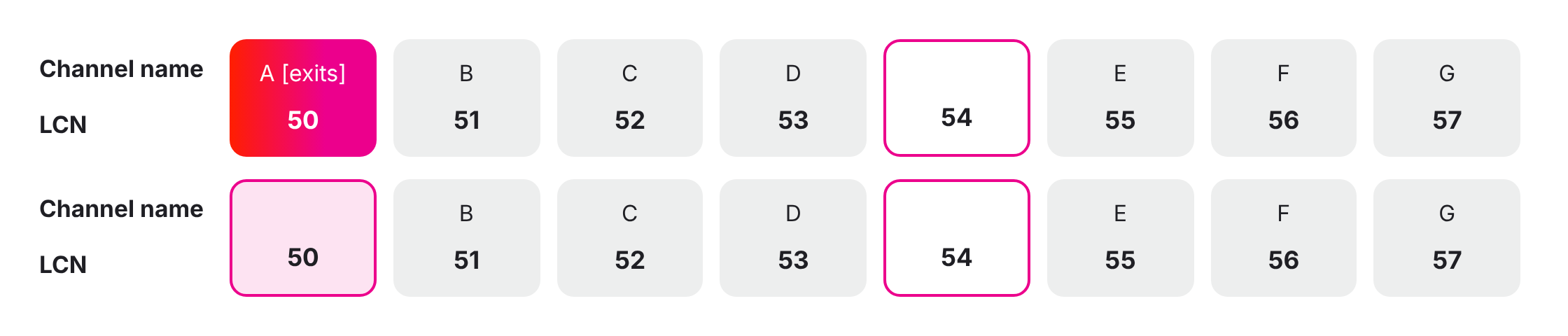
In our example, Channel A in LCN 50 chooses to leave the platform, kick-starting the vacated LCNs procedure. We will assume that no channels meet the criteria set out in the first part of the vacated LCNs procedure22 and that the shuffle-down procedure is initiated. This involves the following steps:
Step 1: Channel B, the channel with the next highest LCN, is offered and accepts the move to Channel A's vacated slot (LCN 50). Channel B's former slot (LCN 51) is now vacant and the next to be offered.
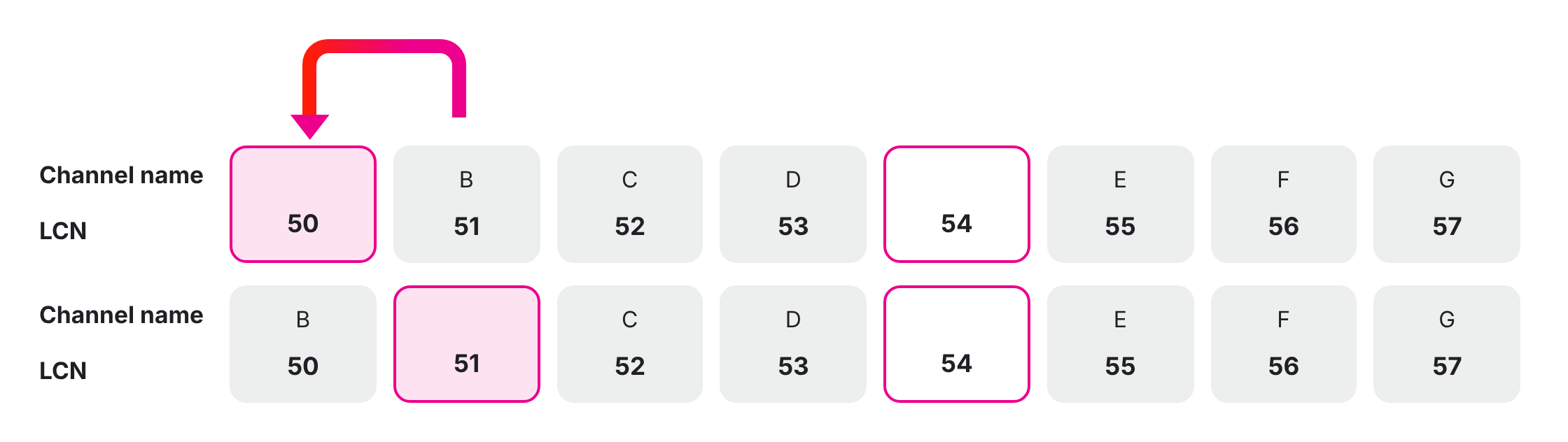
Step 2: Channel C chooses not to move, so Channel D is offered and accepts the move to slot 51. Channel D's former slot (LCN 53) is now vacant and the next to be offered.
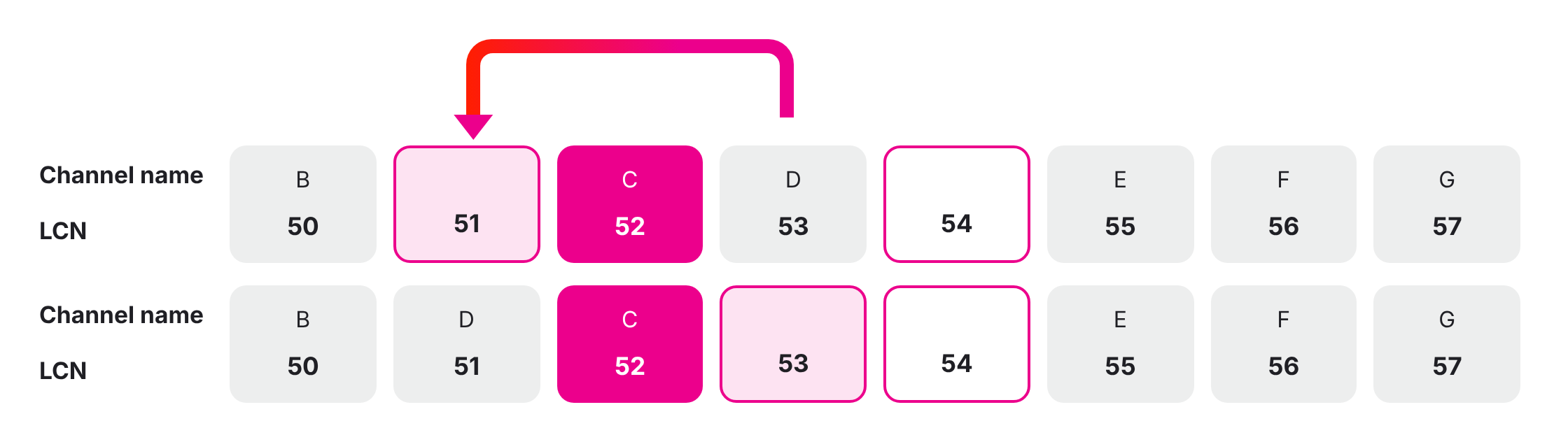
Step 3: Channel E, in the next non-vacant slot, is offered and accepts the move to slot 53, leapfrogging a vacant slot. Channel E's former slot (LCN 55) is now vacant. LCN 54 is also vacant, and as the one with the lowest LCN is the next to be offered.
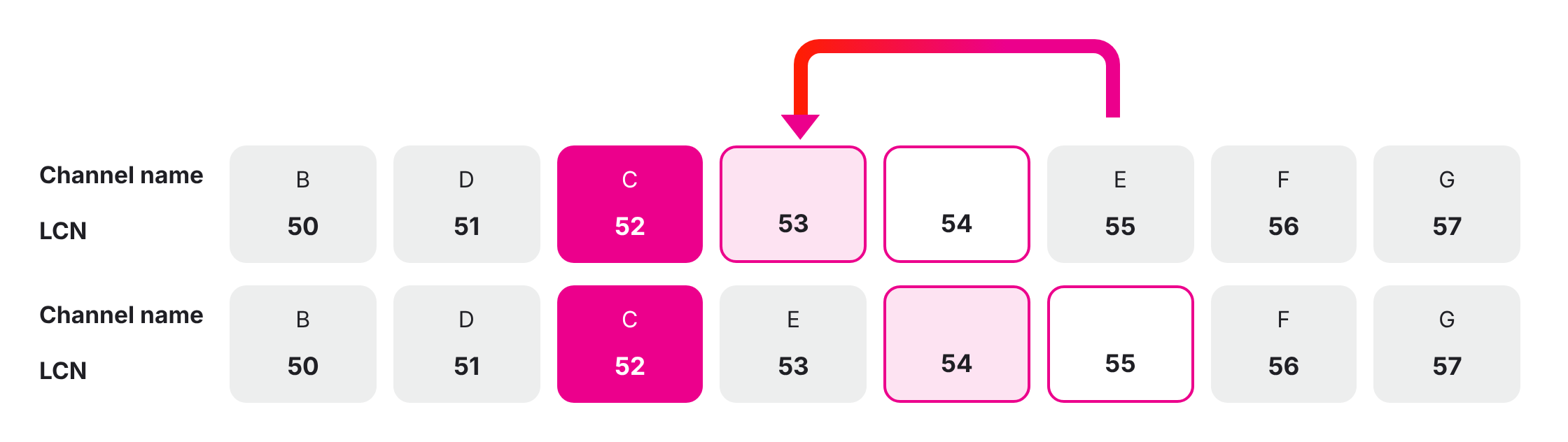
Step 4: Channel F, in the next non-vacant slot, is offered and accepts the move to slot 54 (leapfrogging a vacant slot). Channel F's former slot (LCN 56) is now vacant. LCN 55 is also vacant, and as the one with the lowest LCN is the next to be offered.
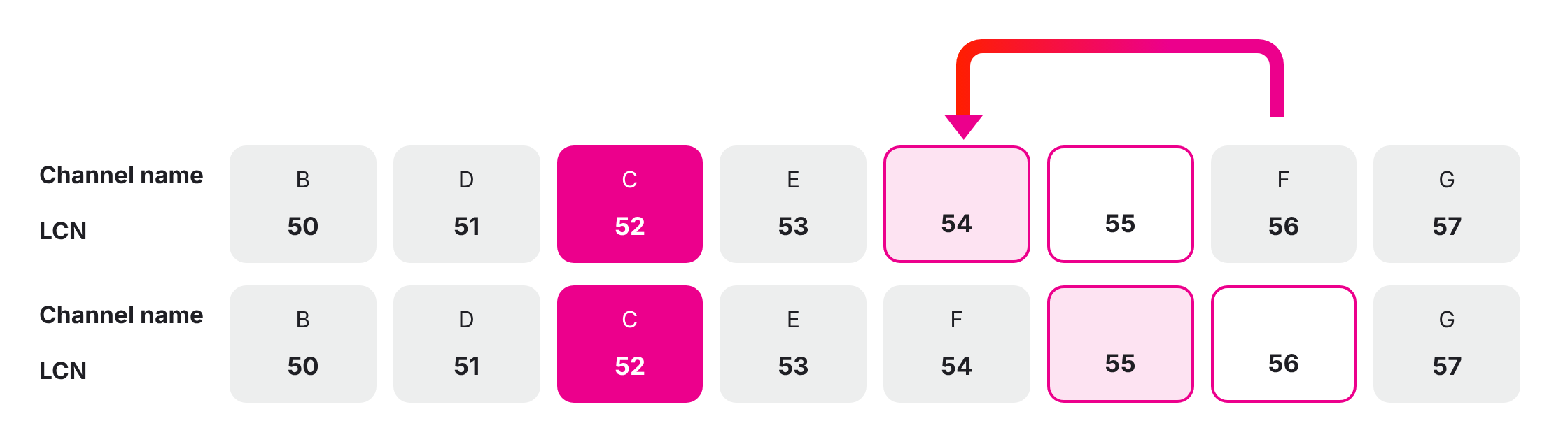
Step 5: Channel G, in the next non-vacant slot, chooses not to move to LCN 55. There are no other channels in the Genre Category. The shuffle-down procedure ends, with four channels (B, D, E and F) moving one or more places to a lower LCN. LCN 55 is considered the next available slot to be offered to the next channel when it launches.

Footnotes
- https://everyonetv.co.uk/freelyinitiallcnstatement
- https://everyonetv.co.uk/freelypromolcnstatement
- See https://www.legislation.gov.uk/ukpga/2003/21/contents
- For example, it might at some point be feasible to use data derived from Freely for those channels for which no BARB or RAJAR data exists, or to use data from the platform as a measure of popularity for all channels (replacing BARB and RAJAR as data sources).
- The regulatory regime around EPGs and around IP-delivered services is subject to change, and this Policy is not prescriptive about what we may determine ‘appropriately licensed’ to mean for channels on Freely. We will engage separately with channel providers on this point. We also note that some channel providers, such as the BBC and S4C, are explicitly excluded in legislation from requiring a broadcast licence: we do consider such services to be appropriately licensed.
- Any requirement of the Freely Content Provider agreements that specifies longer minimum broadcast hours for IP-delivered channels will supersede the requirements of this Policy.
- See Table 1 for the definition of Hybrid Streamed channels and Schedule 2 for the full set of Genre Category definitions.
- https://www.everyonetv.co.uk/sites/everyonetv/files/2024-01/freely-lcn-consultation-statement-jan-2024.pdf
- Radio 1, Radio 1Xtra, Radio 2, Radio 3, Radio 4, Radio 4 Extra, Radio 5 Live, Radio 5 Sports Extra, Radio 6 Music, and the Asian Network.
- All non-BBC radio services will be treated as ‘commercial radio stations’ for the purposes of this Policy.
- For example, this was the case up until 2023 for the HD version of BBC One in England delivered via DTT and DSat.
- So, for example, an HD simulcast of a channel that only broadcasts in the evening would not be considered to be ‘sufficiently similar’ to a 24-hour SD default version of the channel.
- For the avoidance of doubt, ‘reorder’ references in this section are unrelated to the ‘Periodic Reorderings’ process described in Chapter 6.
- See Table 1 for definitions of ‘lower’ and ‘higher’.
- This circumstance corresponds to the situation at the end of Step 3 in the worked example in Schedule 3.
- Any DSat channel that also exists on DTT or is IP-delivered will share an LCN with the other existing versions of the channel, as described in Section 5.5.
- http://everyonetv.co.uk/freelylcnterms
- https://www.everyonetv.co.uk/freelyscopeofaccess
- The regulatory regime around EPGs and around IP-delivered services is subject to change, and the Scope of Access – as amended from time to time – will specify what ‘appropriately licensed’ means
- All subsequent references to the ‘Chair’ in this Chapter should be interpreted as meaning the Chair or nominated person.
- Vacant slots in the figures in this schedule are shown in white, other than the next vacant slot to be filled at each step, which is highlighted in gold.
- Broadly speaking, the vacant slot is offered first to public service channels and then to channels close to the vacated LCN that have a second channel in the same channel family.